Purity and purification
Midnight's ChildrenPurity and purification connect private guilt to national ideology in Midnight’s Children. Pakistan’s name makes purity an ideal, and Jamila Singer’s patriotic performances give that ideal a public voice; Saleem, meanwhile, experiences himself as religiously and culturally mixed, morally compromised, and out of place. The novel’s most consequential reversal comes when war, rather than personal reform, seems to cleanse him: the destruction of his family and the fall of a silver spittoon leave him emptied of memory and shame. Purification is thus both a promise of renewal and a dangerous language through which violence can be presented as necessary.
National Ideals and Religious Authority
At the birth of independent India, Saleem describes the new nation as a collective dream that requires ritual renewal, including rituals of blood. This account places national belonging beside the rival fantasies of money and God: a political community is not simply inherited but imagined and repeatedly affirmed. The language of sanctification therefore carries a cost. Bloodshed can be made to seem like a condition of national renewal rather than a contradiction of it.
In Pakistan, the connection between political identity and religious purity becomes explicit. Saleem’s parents resolve that they must become new people, while the country’s name establishes purity as a governing ideal. Jamila Singer’s rise as a patriotic performer makes that ideal audible in the state’s ceremonies. At a performance for President Ayub, her voice is presented as an instrument for cleansing men’s souls, and she pledges her heart to the president’s will. The perforated sheet through which she sings preserves a barrier between performer and audience even as her song is enlisted in public political devotion. Saleem hears the applause as disciplined approval, not the unrestrained enthusiasm of her earlier popular audience.
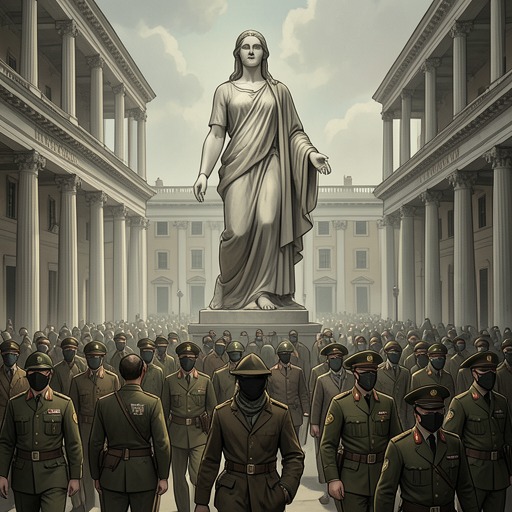
That ceremonial purity is reinforced by the language of military command. At a formal dinner, Saleem and his cousin Zafar are told to stay silent while senior officers discuss politics and recite scripture. The Quranic passage about peoples destroyed after their misdeeds seemed fair to them lends a sacred frame to the dinner’s atmosphere of danger. The boys are both frightened and proud when they are told that their future is at stake. Religious authority here does more than express belief: it helps make political power appear morally charged and historically ordained.
The same fusion of faith, nationalism, and military authority appears in wartime appeals. During the 1965 conflict, Jamila is summoned to sing for Pakistani soldiers, while religious speakers promise a heavenly reward to those killed in battle and call for sacrifice. The language turns military death into a passage toward purity. Yet Saleem’s account also places this confidence beside competing broadcasts that exaggerate the destruction inflicted by each side, exposing how official narratives can turn war into a contest over who speaks with authority.
Saleem as a Misfit in the Land of the Pure
Saleem’s sense of himself is defined by the gap between Pakistan’s ideal and his own inheritance. He describes himself as permanently marked by Bombay and formed among multiple religions, in contrast to the singular religious identity expected of him in the new country. His family’s preference for business ethics over faith is presented as another sign of his distance from the national ideal. He calls himself a misfit, and the difference is not merely geographical: the country’s demand for purity presses against the plural and unsettled self he carries with him.
That mismatch becomes sharper as Saleem grows older. Studying history at his aunt Alia’s college does not make him feel part of a society whose students march for stricter Islamic rules. His parents, by contrast, work to establish roots in Pakistan and reject criticism of their new home. Their commitment makes Saleem’s alienation more visible: the same country that offers his family a new beginning leaves him unable to feel at home within its public definition of belonging.
His private life then deepens his sense of moral failure. Saleem believes that, in the Land of the Pure, he should have been making a new and upright life, but instead he pursues an unrequited love for Jamila. The siblings avoid one another, unable even to speak as they once did. Against the purity voiced through her patriotic songs, Saleem experiences his own conduct as evidence of continuing impurity. He does not treat this as a simple contrast between a virtuous sister and a guilty brother: their complementary gifts, her voice and his nose, are drawing apart as she rises into official patriotism and he remains attuned to what he regards as uglier realities.
Saleem’s interpretation of his guilt is intensified by the political environment around him. He believes that his family’s move from Bombay has initiated a series of reprisals, and that the country’s history may eventually pardon sinners through events on an immense scale. His account makes this belief part of his personal fatalism, not a neutral explanation of the conflict. Purity becomes something he cannot attain through ordinary self-discipline, but can imagine history imposing upon him from outside.
War as an Instrument of Purification
As the 1965 war approaches, Saleem openly connects his private condition to public violence. He claims that the war’s hidden purpose was the elimination of his family, and he describes their domestic life as having reached a state from which the bombing would provide merciful relief. The claim is deliberately personal: he also proposes that the war happened because he dreamed Kashmir into the fantasies of the rulers and because he remained impure. These explanations reveal how he folds national events into the moral shape of his own life, rather than establishing a factual cause of the war.
The uncertainty of the conflict strengthens the novel’s contrast between official certainty and lived confusion. Accounts of infiltration, border crossings, and responsibility differ between India and Pakistan; radio broadcasts give incompatible accounts of military destruction. Saleem’s birthday arrives amid declarations of national strength and assurances that each side will defeat the other. In his family home, blackout precautions are undone when his father opens the windows and turns on the lights, and stones enter through the openings. The episode places political danger within domestic life without making the family’s eventual fate a simple consequence of one individual act.
When a bomb strikes the family home, Saleem interprets the blast as a purification. Amid the destruction, the explosion dislodges a silver spittoon inlaid with lapis lazuli from a trunk where it had been hidden for years. The object falls toward him, and he understands its blow as freeing him. In a brief moment of clarity, he accepts it; afterward, he describes himself as emptied of the past, memory, shame, love, and the desire to find a historical role. The spittoon is not merely a symbol recalled from family history: its physical fall precipitates the loss of Saleem’s former identity and the beginning of his amnesia.
The change is expressed as a sweeping release from the accumulated names, episodes, and relationships that have shaped him. Saleem says he is freed from childhood labels, school experiences, family attachments, and earlier guilt. He understands the impact as restoring innocence and purity, even though it follows the deaths of his parents and other family members. That contradiction is central to the episode: his cleansing is not achieved by repairing the lives damaged by violence but by losing the memories through which he had understood them and himself.
Purification, Partition, and the Limits of the Metaphor
The ceasefire gives Saleem’s account a grim limit. The United Nations announces the end of hostilities on September 23, and the armies have taken territory on both sides. Saleem says that international and political constraints prevented the complete annihilation he had attributed to the war. His survival, and that of others, is therefore linked not to the fulfillment of a purifying design but to the fact that the means of destruction were not fully supplied. The language of cleansing sits beside the contingency of military and diplomatic events.
Saleem’s larger account of Pakistan also associates purity with a severance from history. He links the country’s geographic division into eastern and western wings with a perceived division between past and present. In his interpretation, religion holds the two wings together just as a continuous sense of self connects past and present. He suggests that abandoning consciousness and history sets a dangerous example, and connects this metaphor to the East Wing’s secession under Sheikh Mujib. This is Saleem’s retrospective analogy, not an impartial explanation of the political separation; it shows how strongly he makes national cohesion and personal continuity answer to one another.
The novel finally makes purity an unstable ideal rather than a settled virtue. Saleem’s own cleansing is narrated through a family catastrophe, while the state’s appeals to purity can sanctify obedience, military sacrifice, and exclusion. The child who feels irreducibly plural cannot simply become the new person his family and country demand. Instead, history appears to erase him and call that erasure freedom. Purity and purification thus name both the longing to escape guilt and the peril of treating human complexity as something that must be cleansed away.